Is a UK University Right for You?
Last reviewed: August 2026. Visa fees, health surcharge rates, and Graduate route terms are set by UK immigration policy and change; each figure below links to its current source.
What US Students Need to Know Before They Apply
A UK university is usually the right choice for an American student who already knows the subject they want to study, wants to go deep rather than broad, and is ready to live abroad for three or four years; it is the wrong choice for a student who is still deciding. The degree is typically three years rather than four in England, Wales, and Northern Ireland; tuition and total cost are frequently lower than a comparable US path, and the whole application is built around one course rather than one campus. For interested students, a UK university offers a focused three-year degree, deep engagement with a single subject from day one, and access to some of the most respected institutions in the world, often at a lower total cost than a comparable US degree. Researching the process is the first step, as it is a different system altogether, one that rewards academic depth over breadth, asks for a subject commitment before enrollment, and runs on a timeline most American families may not have encountered. This is Part 1 of a three-part series on UK university applications for students from US high schools, alongside how the UCAS application works and writing a UK personal statement.
Here, we will focus on the structural differences between US and UK admissions, the financial picture, and the question every student and family should answer before they go further.
The US vs. UK Admissions System: Key Differences
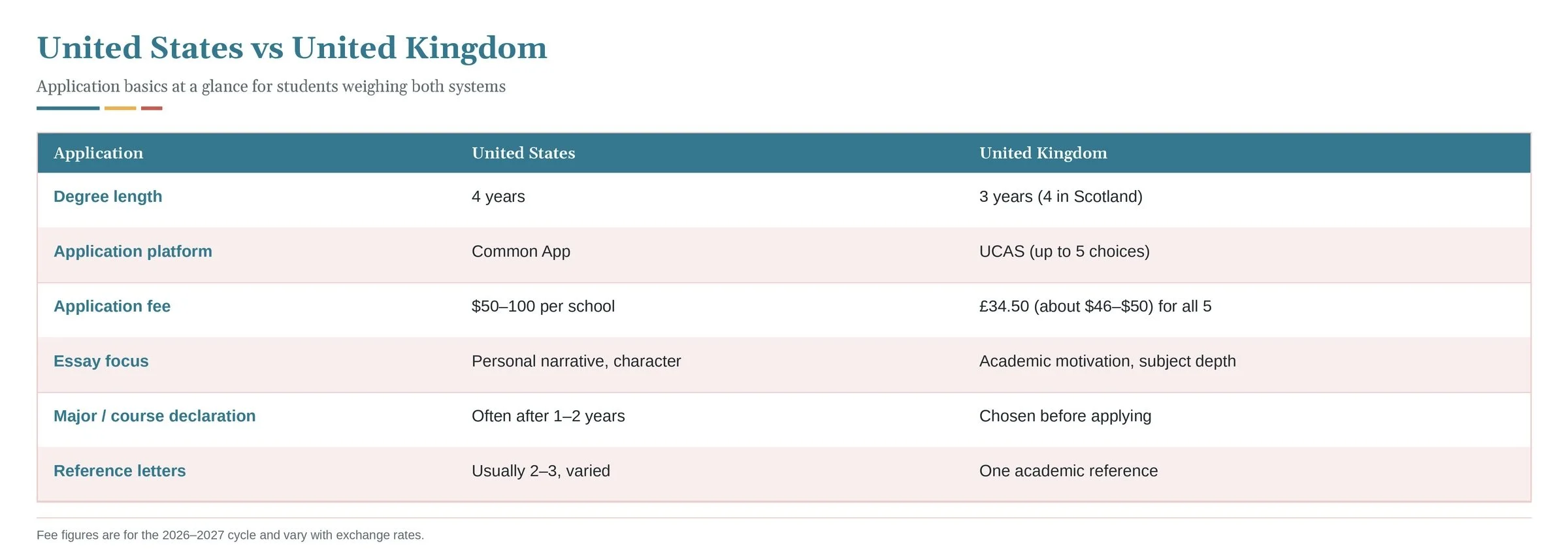
The most important distinction between US and UK admissions is the relationship between the student and their subject. In the US, students often declare a major after one or two years of general coursework. In the UK, students apply to a specific course, not a university at large, and their entire application is built around that subject. A student who is genuinely undecided about what they want to study may find that pursuing a UK university degree is not the best fit. Here is how the two systems compare at a structural level:
What you apply to
- United States: you apply to an institution, and at most colleges you declare a major after one or two years of general coursework.
- United Kingdom: you apply to a named course at a named university, and subject work begins in the first term. UCAS: choosing the right UK course
How many applications you file
- United States: no cap on the number of colleges, and each application typically carries its own fee of roughly $50 to $100.
- United Kingdom: one UCAS application carrying up to five course choices, for a single 2027-cycle fee of £34.50, or up to six choices for a conservatoire. UCAS: 2027 cycle application fee
How long the degree takes
- United States: four years is standard for a bachelor's degree.
- United Kingdom: three years is standard in England, Wales, and Northern Ireland, and four years is standard in Scotland. Placement years, integrated study abroad, medicine, and some other courses run longer. Study UK: cost of studying in the UK
What the curriculum covers
- United States: general education or core requirements sit alongside the major, and breadth is built into the degree.
- United Kingdom: the degree is subject-focused, with no US-style general education core. UCAS: the UK degree system
What the application is judged on
- United States: a composite profile grades, testing, essays, activities, leadership, recommendations.
- United Kingdom: academic evidence in the chosen subject, carried mainly by predicted grades, the personal statement, and a single reference.
What an offer looks like
- United States: admission decisions are generally final once released.
- United Kingdom: most offers are conditional on final results, and are confirmed after those results are published.
Whether you can change direction later
- United States: changing a major within the same institution is routine.
- United Kingdom: a course change is possible but is decided by the university and constrained by your visa. Typical conditions are that the new course sits at the same or a higher level, is related to the original subject, and finishes inside your existing visa. University of Dundee: changing your course or study method
This academic focus is the primary basis on which most UK universities evaluate applicants. Universities in the UK are evaluating whether a student has demonstrated genuine engagement with their chosen field. A broad resume full of leadership roles and varsity sports carries less weight than it does on a US application. What carries weight is evidence that the student has thought seriously, read independently, and engaged with their subject beyond the classroom.
What Does a UK Degree Really Cost for a US Student?
For most American families, a UK degree costs less than the US alternative, often significantly less, once the full three years are priced against a comparable US option.
Published international undergraduate tuition runs from about £11,400 to £38,000 per year, and the spread inside that range is driven by the course as much as the institution humanities and social sciences sit at the low end, laboratory and clinical programmes at the high end. Use the current fee on the course page for the specific course you are applying to rather than a national average. For living costs, budget roughly £1,300 to £1,400 per month in London and £900 to £1,300 per month elsewhere in the UK, covering accommodation, bills, groceries, transport, and everyday spending.
On the US side of the comparison, average published tuition and fees for 2025-26 are $31,880 at public four-year institutions for out-of-state students and $45,000 at private nonprofit four-year institutions, roughly $127,500 and $180,000 across four years at today's prices, before housing, food, and any future increases. Housing and food are on top of both figures, and net price after grant aid is frequently lower than the published price at private nonprofits in particular.
A UK degree is often less expensive, and the shorter timeline is the largest single reason: three years instead of four removes a full year of tuition and living costs, and lets a student start earning a year earlier. It is not automatically cheaper, though. London, a laboratory or clinical course at the top of the tuition range, an unfavourable exchange rate, and immigration costs can close the gap or reverse it. Price your actual UK course against your actual US options rather than against a national average.
What a complete UK cost estimate has to include
- Tuition for your actual course: the published international fee on that course's own page, for the year you would start, not a UK-wide average.
- Living costs, multiplied by the length of the academic year: about £1,300 to £1,400 a month in London and £900 to £1,300 elsewhere, and a UK academic year is typically nine months rather than twelve.
- UCAS application fee: £34.50 for the 2027 cycle, covering up to five course choices. UCAS
- Student visa application fee: £558 applying from outside the UK. GOV.UK: Student visa
- Immigration Health Surcharge: £776 per year of visa length for students, and because the visa usually runs longer than the course, a three-year degree normally means paying for more than three years. A visa longer than 18 months but under two years is charged as two full years. GOV.UK: how much you have to pay
- Flights and travel home: at least two long-haul round trips a year, plus travel at the start and end of the degree.
- Exchange-rate buffer: your costs are denominated in pounds and your income is not, so hold a margin against the dollar moving against you across three or four years.
- Degree length: three years in England, Wales, and Northern Ireland, four in Scotland, longer for placement years and for medicine. Multiply everything above by the right number.
The visa financial requirement is a separate number
Alongside your real budget, a Student visa application can require you to show funds of £1,529 per month for up to nine months for a course in London, or £1,171 per month for up to nine months outside London, held for 28 consecutive days, plus your first year's course fee. This is a proof-of-funds threshold, not an estimate of what living in the UK costs. US nationals appear on GOV.UK's differential evidence requirement list, which means you are not normally asked to submit this evidence up front, though UK Visas and Immigration can request it before deciding your application. GOV.UK: money you need
The application itself is cheaper too for the 2027 cycle; a single £34.50 UCAS fee covers up to five course choices, against roughly $50 to $100 per school in the US system, and fee waivers exist for care leavers and for students who have received UK government-funded free school meals. UK universities also award little need-based aid to international students, so the published price is close to the actual cost. That is worth something on its own: a family can build a UK budget on the numbers above with real confidence, rather than waiting on an aid letter to find out what a degree will actually cost.The Right Question Before Proceeding
Before investing time in building a UK list, it helps to answer one question: Does this student have a subject they are genuinely committed to studying at the undergraduate level? This means more than a rough direction or a general area of curiosity. It means a focus specific enough that the student could write compellingly about why they want to study it, how they have prepared for it academically, and what they have done outside of class to engage with it.
If the answer is yes, the UK deserves serious consideration. If the answer is no, the next step is developing that clarity first, and then revisiting the UK as an option.
In Part 2, we cover the UCAS application itself: how it works, what US high school credentials look like through a UK admissions lens, and the deadlines students cannot miss.
College Flight Path® offers specialized UK application support through its World Explorer Package. Stacy Soricelli, CFP’s Senior College Counselor and a registered UCAS adviser, serves as a co-pilot for students pursuing UK entry. To learn more, visit collegeflightpath.com. Schedule a consultation →
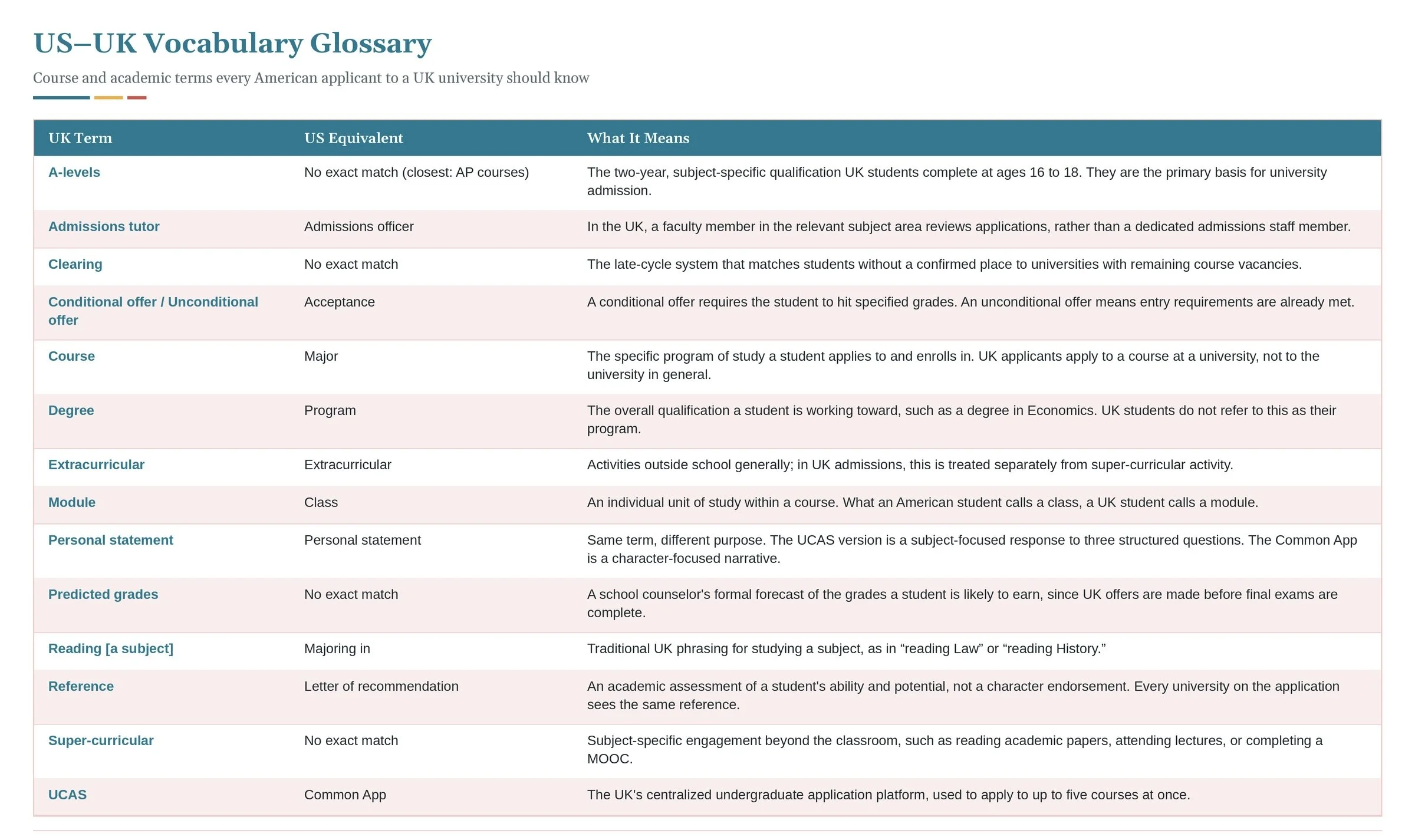
Appendix: US-UK Vocabulary Glossary
A Companion Reference to the UK University Blog Series
Several everyday words carry different meanings across the US and UK higher education systems. This glossary collects the terms most relevant to American students and families researching UK universities, referenced throughout this three-part series, so student and families can navigate the application process with the right terminology in hand.