
College Art and Architecture Portfolio Deadlines, Requirements, and AI Policies
Last reviewed: August 2026 · Covers Fall 2027 entry (2026–27 application cycle)Many families assume a portfolio is due before the general college application. For most art and design programs, that assumption is backward. Layered on top of the deadline sequence is a newer complication: how each program treats artificial intelligence in a submitted portfolio, a policy question with real admissions and financial consequences and no single, consistent answer across schools.
What Belongs in the Portfolio
Image count requirements vary by school, typically landing between eight and twenty pieces, but the number matters less than the instruction nearly every program repeats in some form: submit the strongest work, not the most work. A portfolio padded to the maximum count with weaker pieces performs worse than a tighter set of a student’s best material.
Reviewers consistently look for range and thinking over polish and repetition. Programs commonly evaluate craft and technique, exploration, concept and point of view, problem solving, and context, and the goal is to see a personal perspective rather than a set of technical exercises. Process work belongs alongside finished pieces: sketchbook pages, preparatory studies, and early-stage exploration reveal how a student arrives at a final piece, and many reviewers find that more informative than the finished product itself. Most programs also ask for work completed within the last one to two years, since the portfolio should reflect a student’s current ability.
Architecture portfolios use the same platforms and image counts as visual arts and design portfolios, but the underlying evaluation differs. Architecture programs assess spatial reasoning and design thinking alongside artistic ability, and a portfolio built primarily around drafting exercises will underperform against those criteria.
Several architecture programs explicitly welcome applicants without formal architecture training and accept drawing, painting, sculpture, or other creative work instead. A small number of highly selective programs go further, replacing the static portfolio with a timed test of drawing and conceptual problem solving, precisely because a timed exercise cannot be prepared for in advance the way a curated portfolio can.
How Portfolio Deadlines Line Up With the General Application
This is the detail that catches many families off guard, and not in the direction most assume. Portfolio deadlines commonly do not fall before the general application deadline. At California Institute of the Arts, for example, the portfolio and the full application share the same January 5 deadline for the 2026 admission cycle. At Parsons School of Design, the visual portfolio is submitted after the Common Application, not on an earlier separate date, and both are due together. Savannah College of Art and Design removes the sequencing problem altogether by admitting on a rolling basis with no fixed deadline at all.
2026–27 portfolio deadline and submission tracker
| School / Program | Application Deadline | Portfolio Pieces | How It Is Submitted | Sequence |
|---|---|---|---|---|
| RISD | ED Nov 1 · RD Jan 20 | 12–20 works | SlideRoom, opened after starting the Common App | Portfolio follows the application |
| MICA | RD Feb 1 | 10–15 pieces | Applicant portal, after application submission | Portfolio follows the application |
| SAIC | Nov 15 priority merit · Jan 15 final merit · Apr 15 final application | 10–15 works | SlideRoom, accessed via the Common App | Portfolio with the application |
| Parsons (BFA) | Common App first, portfolio link sent afterward | 8–12 slides | Parsons portfolio link | Portfolio follows the application |
| Cornell (B.Arch) | ED Nov 1 · RD Jan 2 | 15–20 slides + video interview | SlideRoom | Portfolio deadline precedes the Common App deadline |
| SCAD | Rolling, no fixed date | Optional | SCAD portal | Portfolio is for scholarship consideration, not admission |
Not every program uses the same structure, and the exact relationship between the two deadlines varies by school and by round. There is no reliable universal rule. The only safe approach is to confirm the specific deadline sequence for every program on a student’s list individually, since an assumption carried over from one school’s process will not necessarily hold at the next.
Beyond the admissions deadline itself, students have a low-stakes opportunity to get feedback before they submit. National Portfolio Day events, held around the country, connect students with representatives from art and design schools who review portfolios in person and offer guidance. These events do not replace the formal submission process and no admissions decisions are made there, but they give a student time to address weaknesses while a portfolio can still be revised.
What a Missed Portfolio Deadline Costs
Letters of recommendation often carry an earlier due date than either the portfolio or the general application, since teachers and counselors need time to write and submit them before a student’s own materials are complete. FAFSA priority deadlines run on a separate clock as well, unrelated to admissions or portfolio timing. Families who wait until after an admission decision to file the FAFSA risk missing a school’s priority window for need-based aid, even when the application and portfolio were both submitted on time.
Missing a portfolio or application deadline can remove a student from consideration regardless of academic record or portfolio strength. Outside of a rolling-admission program, the realistic options after a missed deadline are limited: waiting a full additional year to reapply with a stronger portfolio, or applying instead as a transfer student. Neither option is preferable to tracking the deadline correctly the first time.
The stakes extend beyond admission itself. At many art and design schools, portfolio strength is one of the most heavily weighted factors in merit scholarship decisions, and a stronger portfolio can meaningfully change the size of the award offered. Merit aid tied to the portfolio is separate from external scholarships a student can pursue independently. Programs such as the Scholastic Art and Writing Awards and YoungArts evaluate creative work outside of any single school’s admission process and can add both recognition and funding regardless of where a student ultimately enrolls. Families focused only on need-based aid through the FAFSA are leaving one additional funding channel unexamined.
Where Programs Stand on AI in Portfolios
Artificial intelligence has entered the portfolio review process in a way most families have not yet registered, and the institutional response is neither settled nor consistent. Where a policy exists, it tends to fall into one of a few recognizable postures:
| Posture | What it means | What a student must do | Example |
|---|---|---|---|
| Disclosure required | AI use is permitted but must be declared, including tools and process. | Document every tool used and where it entered the work. Non-disclosure is the disqualifying act, not the use. | CalArts, Parsons, RISD |
| Process only | AI allowed for research and ideation; finished submitted work must be human-made. | Cite prompts and platforms. At CCS, AI-related work is capped at one portfolio piece and final AI images are not accepted for admission. | College for Creative Studies |
| Prohibited | AI-generated imagery is not accepted and portfolios may not be outsourced. | Submit only original work. Disclosure does not create an exception here. | Cornell AAP (B.Arch) |
| No published policy | The school has not addressed AI in portfolios publicly. | Treat silence as risk, not permission. Default to fully independent work. | Most programs |
Two published policies are worth reading in full. College for Creative Studies permits AI for process and research only, prohibits fully AI-generated final images in an admissions portfolio, requires students to cite the prompts and platforms they used, and caps AI-assisted work at a single piece. Cornell's architecture program takes the opposite line: portfolios cannot be outsourced and cannot include AI-generated images. AP Art and Design sits in between; its 2026–27 rules allow limited use of AI in ideation and process documentation with attribution, while final submitted work must be the student's own, and violations can result in score cancellation.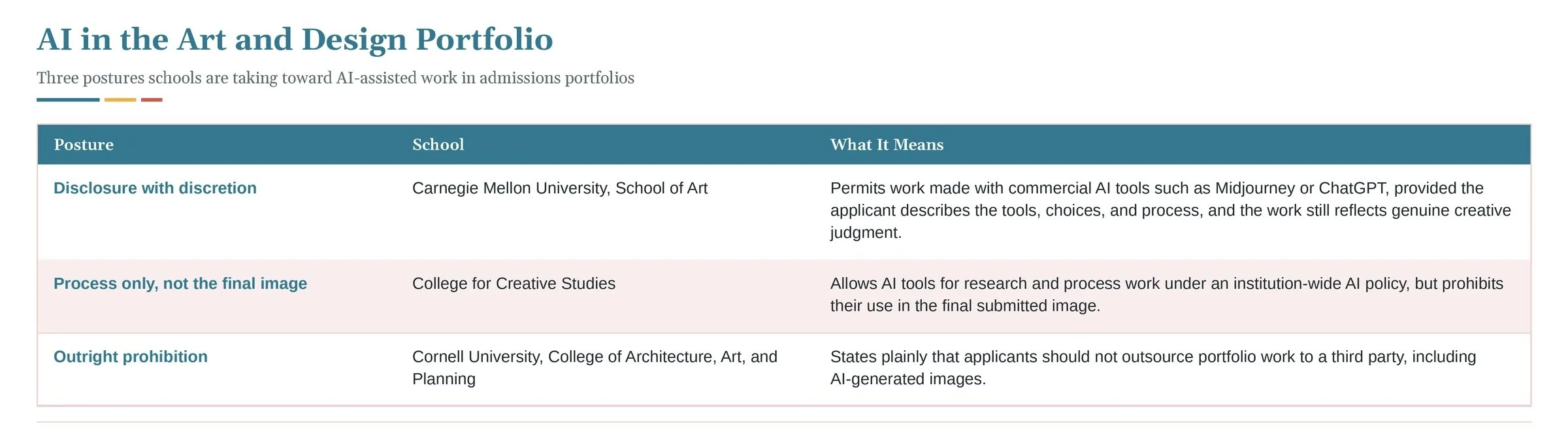
Under a disclosure model, using AI is not automatically disqualifying. Failing to disclose it is the real risk, since undisclosed AI use found in submitted materials can trigger additional review of the entire application. Under a prohibition model, disclosure does not create a workaround: the material itself is unacceptable if it was not substantially the applicant’s own creative labor.
It is worth noting that AI is entering the admissions process from the institutional side as well, a distinct issue from whether applicants may use it. The School of the Art Institute of Chicago has used machine learning on its admissions office side to help forecast which admitted students are most likely to enroll, a use of AI aimed at enrollment strategy rather than portfolio evaluation. AI’s presence in the admissions process now runs in both directions.
A student applying to multiple programs across these different postures cannot use a single standard for the entire application cycle. What is welcomed at one school may be restricted to process work only or prohibited outright at another, and a number of programs have not addressed the question publicly at all, which is its own kind of risk, since silence does not mean permission.
How to Approach AI Use in a Portfolio Right Now
The practical guidance is more straightforward than the policy landscape itself:
Look up the specific AI policy for each program on the list directly, rather than assuming continuity from one school to the next.
Where AI played any real role in developing a piece, default to disclosure rather than silence. Over-disclosing to a school that did not require it carries far less risk than under-disclosing to one that did.
Treat full independence from AI in the finished work as the steadiest position, regardless of any single school’s stated policy. A student who used AI tools only for early brainstorming, with the actual drawing, design, or composition entirely their own, is on safer ground than a student who used AI to generate or substantially refine the finished piece.
This is also a genuinely moving target. Guidelines published this year may be revised again before the next admissions cycle, since programs are still calibrating how much latitude to extend to a technology evolving faster than the review processes built to evaluate it.
The deeper point is not really about compliance with any one school’s rule. A portfolio is supposed to demonstrate a student’s own developing skill and creative judgment. A piece produced substantially by AI, even where technically permitted, tells a reviewer less about what a student can do than a rougher, more honest piece made entirely by hand. That gives a student a longer runway to build a body of work that holds up regardless of how any individual school’s policy evolves.
Where to Build Portfolio Skills This Summer
A number of the schools discussed above, along with several other art and design programs, run summer pre-college studios built around portfolio development. Formats, costs, and eligibility vary considerably, so families should confirm current details directly with each program before applying.
Temple University, Tyler School of Art & Architecture (Philadelphia, PA): Portfolio Bootcamp is a two-week, in-person intensive for 11th and 12th graders built around observational drawing from live models. Tyler also runs a separate Architecture Institute for 10th–12th graders.
Pennsylvania Academy of the Fine Arts (Philadelphia, PA): The four-week, college-level Summer Academy is designed for motivated high school students; PAFA also offers Saturday Studio classes aimed at portfolio-building for teens.
Rochester Institute of Technology, School of Art (Rochester, NY): The two-week Pre-College Portfolio Preparation Workshop focuses on still-life and figure drawing for rising juniors and seniors; no on-campus housing is offered.
School of Visual Arts (New York, NY): SVA’s Pre-College Program runs fall, spring, and summer terms, with the summer session earning three college credits; students may live in an SVA residence hall in Manhattan.
University of Michigan, Stamps School of Art & Design (Ann Arbor, MI): Portfolio Prep is offered as a two-week virtual session or two two-week residential sessions for grades 9–11, alongside a BioDesign Studio combining art with materials science.
Massachusetts College of Art and Design (Boston, MA): The four-week Pre-College Summer Studios program is modeled on MassArt’s Foundation year and offers both on-campus and virtual sections for rising juniors and seniors.
Boston University, School of Visual Arts (Boston, MA): The Visual Arts Summer Institute is a commuter-only, credit-bearing program for students ages 15–18; no residential housing is provided.
Carnegie Mellon University, School of Art (Pittsburgh, PA): Pre-College Art offers 3-week and 6-week formats with courses in drawing, sculpture, animation, painting, photography, and printmaking; the program does not carry college credit but includes faculty portfolio reviews.
The Cooper Union, School of Art (New York, NY): The Summer Art Intensive is a commuter program for rising sophomores through seniors with concentrations in drawing, animation, painting, and graphic design; it does not offer college credit or housing.
Maryland Institute College of Art (Baltimore, MD): The Pre-College Summer Intensive runs two two-week sessions or a combined four-week option, in residential or commuter formats, for students ages 15–17, with a required admissions portfolio review built into the program.
University of North Carolina School of the Arts (Winston-Salem, NC): The four-week Visual Arts Summer Intensive is open to ages 14–18 and explicitly does not require prior experience or a portfolio, making it more exploratory than portfolio-focused compared to several programs on this list.
Virginia Commonwealth University, VCUarts (Richmond, VA): The three-week Summer Pre-College Program lets rising sophomores through seniors take one non-credit studio course, with residential and commuter options.
School of the Art Institute of Chicago: The Early College Program Summer Institute offers one-, two-, and three-week sessions for ages 15–18, each earning a college credit per week attended, with courses aimed at building a competitive admissions portfolio.
Otis College of Art and Design (Los Angeles, CA): Summer of Art is a four-week program for ages 14.5–19 offering up to three transferable college credits and a required Drawing Studio component alongside a chosen specialization.
UCLA Architecture and Urban Design: TeenArch Studio is a three-week architecture program for students in grades 9–12, offered in-person or remotely, carrying UC quarter-unit credit; note this is an architecture design studio rather than a visual arts portfolio program.
Missing a single portfolio deadline can disqualify an applicant regardless of academic record. Contact College Flight Path® now https://bit.ly/3Oq3Pkg to map every application, portfolio, and financial aid deadline on a student’s list before any of them passes.