
How to Apply to UK Universities as a US Student
Navigating UCAS, Credentials, and Deadlines
UCAS is the UK’s centralized application platform, and it remains the primary route to undergraduate admission at the large majority of UK universities. A smaller number of UK universities also accept the Common App, covered later in this section. Understanding how UCAS works, and how UK universities reads US credentials, matters a great deal. Getting both right helps the application reflect the student's actual qualifications.
This is Part 2 of our series on UK university applications for US high school students. Part 1 covered whether the UK is the right fit and what to expect financially. Here, we walk through the UCAS application mechanics, how US coursework is evaluated, and the deadline structure that governs the entire process.
How UCAS Works
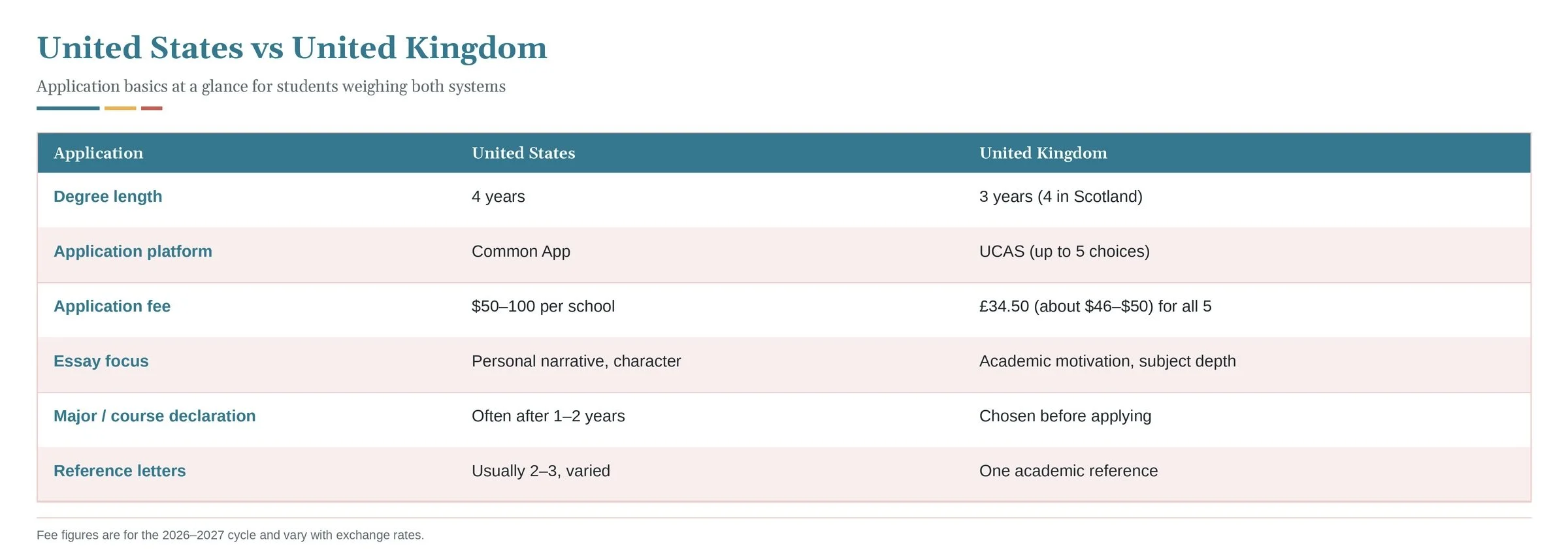
UCAS (Universities and Colleges Admissions Service): The centralized UK application system through which students apply to up to five courses at UK universities. All five choices are submitted simultaneously through a single application, and universities cannot see each other’s entries on the list.
The application includes the following components:
Personal details
Education history (all completed and pending qualifications)
Employment history (if applicable)
Up to five course choices
Personal statement (structured in three sections)
One academic reference from a teacher or school counselor
The application fee is £34.50 and covers all five choices. Applications for 2027 entry open in May 2026, with submission possible from September 2026. Critical deadlines for 2027 entry:
UCAS applications for 2027 entry opened on 12 May 2026. Completed applications can be submitted from 1 September 2026, once the academic reference is attached.15 October 2026 at 18:00 UK time is the equal consideration deadline for any 2027 entry course at Oxford or Cambridge, and for most courses in medicine, dentistry, and veterinary medicine or science. Choices with a later deadline can be added afterwards, up to five in total.13 January 2027 at 18:00 UK time is the equal consideration deadline for every other undergraduate course. Applications that arrive by this time must be considered equally by course providers.25 February 2027 is when Extra opens, for applicants who have used all five choices and hold no offers.30 June 2027 at 18:00 UK time is the last point at which applications are passed on to universities and colleges. After that they enter Clearing automatically, and Clearing opens on 2 July 2027.23 September 2027 at 18:00 UK time is the final date for any 2027 entry application. 18 October 2027 is the last date to add a Clearing choice.Applications for deferred entry follow the deadlines of the cycle in which they are submitted, not the year the course starts.
Missing the October deadline for Oxford, Cambridge, and medical programs generally cannot be recovered within that cycle. There is no UK equivalent of US rolling admissions. The UK system runs on fixed cycles, and late applications are handled differently.
Common App vs. UCAS: Which Should You Use?
Most UK universities can only be reached through UCAS. A smaller group of UK universities also accept the Common App, which at first glance may seem like the preferred application route. UK institutions currently listed as Common App members include the University of St Andrews, the University of Aberdeen, the University of Glasgow, the University of Stirling, Edinburgh Napier University, and the University of Worcester. Membership changes from year to year, and the Common App Explore directory is the only reliable place to check it before a course list is built around one of these institutions.
However, there are few instances in which applying via the Common App actually benefits the student.
For most students, UCAS remains the stronger route, even to a university on this list. It keeps a family within the course-based system this series describes throughout, and it allows up to five choices on a single application. Some allow a Common App submission to run alongside a UCAS application, though the rules on how the two interact, and whether a Common App submission affects a student’s five UCAS choices, vary by institution and should be confirmed directly with each admissions office.
How US Credentials Are Evaluated
UK admissions teams are not unfamiliar with US transcripts, but they evaluate them through a lens that is different from what American students expect.
GPA: A strong GPA is expected. Competitive programs at selective institutions typically look for a 3.7 or above, though thresholds vary. A high GPA on an undemanding transcript tends not to offset a lack of academic rigor.
AP courses and scores: This is where US students have a genuine advantage. AP courses are well recognized across UK institutions as evidence of academic preparation comparable to A-levels, the UK’s own subject-specific qualification. Scores of 4 and 5 are expected for competitive programs. Students should list all completed and predicted AP course grades and exam scores in the education section, with accurate score reporting.
SAT and ACT: Requirements vary significantly by institution. The UK system assumes a level of subject specialization that the American general education model does not build in until later, so transcripts alone are not directly comparable across the two systems. Standardized test scores give UK admissions teams a benchmark they can weigh consistently across applicants from different school systems. Students should research each institution’s specific requirements.
IB Diploma: The International Baccalaureate Diploma is graded out of 45 points and is well understood by UK admissions teams as evidence of sustained academic rigor, on par with A-levels. Offers are typically expressed as a total point requirement rather than a UCAS Tariff conversion, and they weigh most heavily the Higher-Level subjects most closely tied to the course. Competitive ranges vary by tier. Extended Essay and Theory of Knowledge scores factor in but do not substitute for strong subject-specific Higher-Level grades.
The critical difference for US students: The UK system prioritizes subject-specific academic depth over breadth of achievement. A student with five AP courses in the sciences, strong scores, and documented independent engagement with their chosen field is likely to outperform a student with fifteen activities and a 4.0 from a less rigorous program. The transcript needs to tell a story about intellectual focus, not just effort.
Building a UCAS Course List
Five choices can feel limiting to American students accustomed to applying to a dozen or more schools, which makes each one a strategic decision that requires real research. Students applying to competitive programs should not fill all five slots with reach schools. A realistic list includes a mix of ambition and academic fit, with each course chosen because the student can genuinely articulate why they want to study it at that institution. Universities do not see each other on the list, but they can see if a personal statement was clearly written for one type of course and submitted to five different ones.
Use the UCAS course search tool and Discover Uni to research entry requirements, course content, and student outcomes. Unibuddy, available through UCAS, connects prospective students with current undergraduates at UK institutions and is one of the most underused research tools available.
For students considering Oxford, Cambridge and the Russell Group, entry requirements are among the most competitive in the UK system. Many of them rank in the global top 100 (QS Rankings 2027). The research infrastructure, career outcomes, and institutional resources are significant. They are also high-bar applications that require preparation well in advance.
UK University Typology
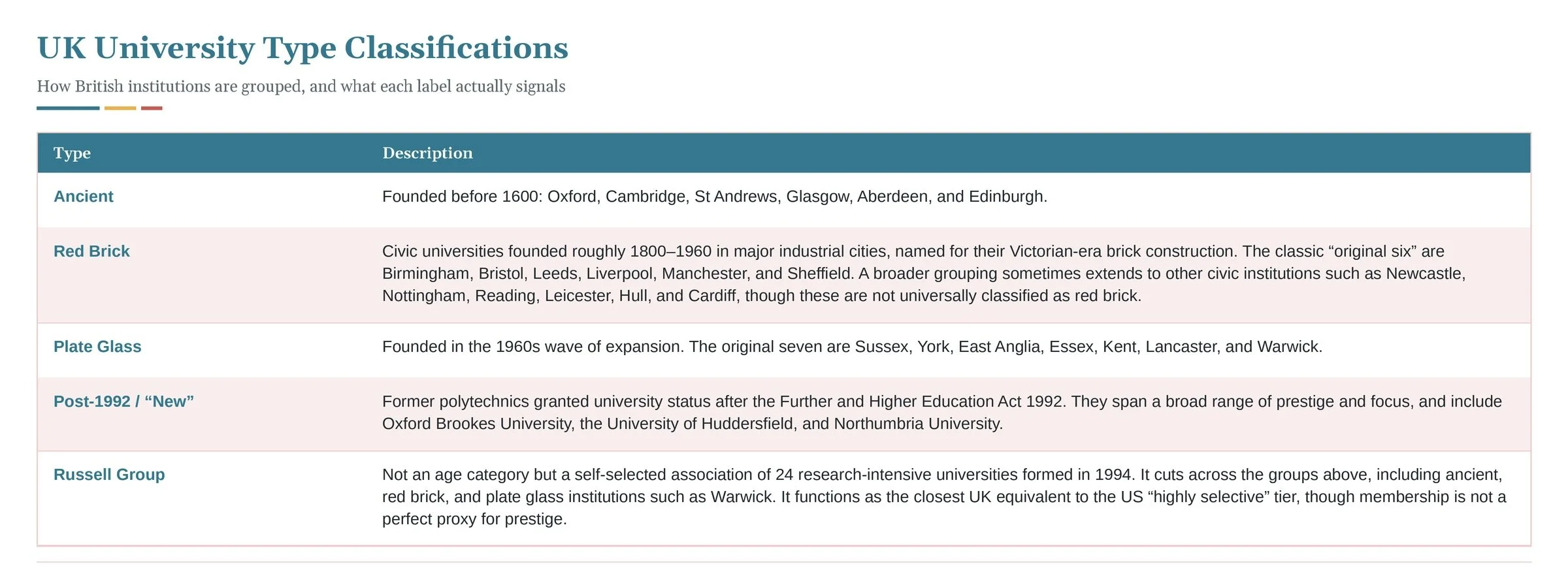
Ancient universities are the oldest institutions in the UK and include Oxford, Cambridge, and St Andrews. They carry their own traditions and set high academic entrance criteria.Oxbridge is the collective term for Oxford and Cambridge. A student may apply to one of the two in a given cycle, never both.Redbrick universities gained university status before the First World War and are usually named as Birmingham, Bristol, Leeds, Liverpool, Manchester, and Sheffield. Many began with vocational strengths such as engineering and are city-based rather than campus-based.Plate-glass universities date from the early to mid 1960s: York, Lancaster, East Anglia, Sussex, Essex, Kent, and Warwick. They are often campus-based.The Russell Group is an association of 24 large, research-intensive universities, and it includes ancient, red brick, and plate-glass institutions. It is not a complete list of selective UK universities. Bath, St Andrews, East Anglia, Lancaster, Leicester, and Loughborough all sit outside it.Post-1992 universities, sometimes called new or metropolitan universities, are mostly former polytechnics and colleges of higher education that gained university status under the Further and Higher Education Act 1992. Nottingham Trent University, Liverpool John Moores University, and Manchester Metropolitan University are examples.Collegiate universities are made up of colleges that a student belongs to alongside the university itself: Oxford, Cambridge, Durham, Lancaster, York, and Kent. At Oxford and Cambridge, teaching as well as residence is tied to the college.
The Reference: What Students and Their Counselors Need to Know
The UCAS reference is a single academic reference submitted by the student’s school counselor or a teacher who knows the student’s academic work. Unlike US recommendation letters, it is not supplemented by additional voices from coaches, mentors, or employers. The reference carries significant weight and needs to speak directly to the student’s academic ability and readiness for the specific subject area.
US school counselors submitting UCAS references should be aware that the format and expectations differ from a Common App recommendation. The reference should address academic performance, subject engagement, predicted grades where applicable, and the counselor’s assessment of the student’s readiness for UK university study. Accuracy matters. Universities use predicted grades and reference assessments in making conditional offer decisions.
In Part 3, we cover the personal statement: the new three-section format, what UK universities are evaluating, and the specific adjustments US students need to make to write a statement that works.
After You Apply: Offers, Firm and Insurance
Universities reply through UCAS Hub with one of three outcomes: a conditional offer, an unconditional offer, or an unsuccessful decision. A conditional offer means the place is held subject to conditions the student has not met yet, almost always exam results.

Once every choice has been replied to, the student names a firm choice and, if the firm offer is conditional, an insurance choice. The firm is the first choice: meet its conditions and the place is confirmed. The insurance is the backup, taken up only if the student misses the firm conditions but meets the insurance conditions. An insurance choice only does its job if its conditions are genuinely lower than the firm.

There is no second look on results day. Firm and insurance are locked in when the student replies, so both need to be places the student would be happy to attend.

UCAS sets a reply date based on when the last decision arrives. Offers left unanswered past that date are declined automatically, which UCAS calls decline by default.

Firm and insurance are UCAS terms that have no US equivalent, and they are the part of the process American families most often misread.
Extra and Clearing
Applications that arrive after 13 January 2027 are still passed to universities, but providers only have to consider them if places remain once the on-time applications have been dealt with. For courses with a 15 October deadline, it is unusual for a late application to be considered at all.
Extra opens on 25 February 2027. It is for applicants who have used all five choices and are holding no offers, and it allows one further choice to be added at a time. The last day to add an Extra choice is 1 July 2027.
Clearing opens on 2 July 2027 and runs through results day. It matches applicants without a place to courses that still have vacancies. Applications received after 18:00 UK time on 30 June 2027 enter Clearing automatically, and 18 October 2027 is the last date to add a Clearing choice.
UCAS publishes a separate Clearing guide for international students. A US applicant who finds a place through Clearing is starting the visa process very late in the summer, which is the main practical reason to treat Clearing as a fallback rather than a plan.
College Flight Path® guides students through the full UCAS application, including credential translation, course list strategy, and reference coordination, acting as a co-pilot from the first course search to the final submission. CFP’s World Explorer Package includes UCAS support. Learn more at collegeflightpath.com. Schedule a consultation →