When the College Search Is a Matter of Safety:A Practical Guide for Families Navigating Severe Food Allergies
For most students, the college search revolves around academics, location, campus culture, and cost. For families managing a child with severe, life-threatening food allergies, those criteria still matter - but they sit behind a more fundamental question: Is this campus safe?
That question is not rhetorical. Anaphylaxis is a medical emergency. A dining hall without proper allergen protocols is not an inconvenience; for a student with anaphylaxis risk, it is a genuinely life-threatening environment. And because programs change from year to year, because dining contracts shift, and because no two campuses operate the same way, this part of the college search requires the same scrutiny that a family would apply to any other life-changing decision.
This guide is designed to give families a framework: what to look for, which schools have built infrastructure worth examining closely, how the law protects your student, and what questions to ask before your student signs a housing contract.
What Separates a Strong Allergy Program from a Superficial One
The presence of a label on a cafeteria sneeze guard does not constitute an allergy program. Neither does a vague statement on a dining services website. What families should be evaluating is infrastructure - the combination of physical spaces, trained personnel, documented protocols, and institutional accountability.
The most important distinction is between allergen awareness and allergen prevention. Awareness means the dining staff knows what the Big 9 allergens are. Prevention means those allergens cannot reach your student's plate through cross-contact, mislabeling, ingredient substitution, or staff error. Prevention requires dedicated physical space, separate cookware, trained supervision, and a system that does not rely on any single employee remembering a single student's needs.
Key Question: Does the school have a dedicated allergen-free kitchen or cooking station - physically separated from the main kitchen - with its own cookware, utensils, and trained staff? If the answer is "we can accommodate requests," that is awareness. It is not prevention.
The vetting checklist below reflects the criteria that distinguish a program your student can rely on from one that will require constant self-advocacy with every single meal.
Critical Criteria - Non-Negotiable
Dedicated allergen-free kitchen or prep station, physically separated from the main kitchen
Registered dietitian on staff available for individual student planning - not just upon request
Dining staff trained in epinephrine auto-injector administration
Written, documented anaphylaxis emergency protocol in all dining facilities
A hospital with an emergency room within 15 minutes of campus
High Priority Criteria
Full ingredient and allergen labeling on every menu item, updated in real time
Digital menu system with allergen filtering (examples: myDining, NetNutrition, FreshDining)
Pre-arrival meeting with the chef and dietitian before the first semester begins
Food allergy formally recognized under disability accommodations - not just dining services
Supporting Criteria
Flexible meal plan options that reduce exposure in higher-risk dining situations
Epinephrine auto-injectors stocked inside dining facilities - not only at the health center
On-campus health center with documented anaphylaxis response capability
FARE (Food Allergy Research and Education) recognition or participation
CFF (Certified Free From) program certification
The FARE College Food Allergy Program: A Useful Starting Point
Food Allergy Research and Education (FARE) operates a College Food Allergy Program that evaluates institutions across three criteria: ingredient information available online, allergen-friendly dining stations, and whether the disability office formally processes accommodation requests. Schools that meet all three criteria at the highest level are classified as Tier 1; schools that meet at least one are classified as Tier 2.
The FARE list is a useful screening tool. It is not a safety certification. A Tier 1 designation means the institution has taken verifiable steps to support food-allergic students - it does not guarantee that your child's specific allergen combination is covered. Every school on the FARE list still requires direct vetting.
College Flight Path has compiled a database using FARE’s resource. It includes 156 institutions that appear most on our students’ lists. The majority of colleges in the United States have not yet built the infrastructure to earn a FARE designation.
The FARE list is where the research starts - not where it ends. A school's absence from the list is a warning sign. Its presence is an invitation to ask harder questions.
The Spokin Top 100: What Student-Reported Data Adds to the Picture
FARE evaluates institutional policy and infrastructure. Spokin measures something different and equally valuable: the lived experience of students who are managing food allergies on these campuses. The Spokin app aggregates reviews from food allergy and celiac students, and each year publishes a ranked list of the most allergy-friendly colleges based on that community feedback.
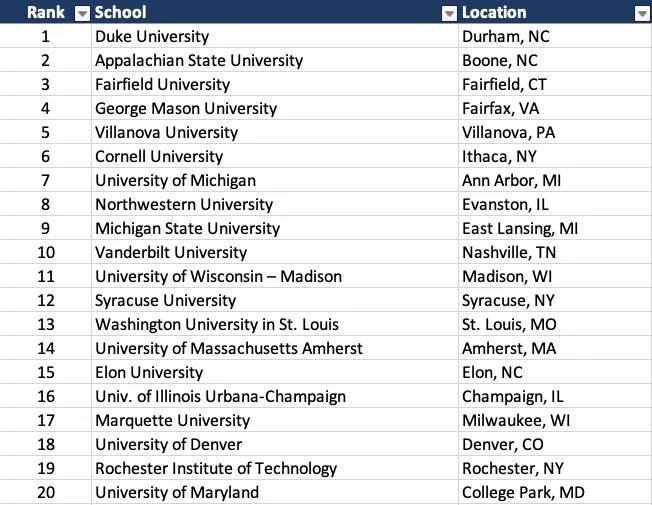
The 2026 Spokin Top 100 named Duke University as the most allergy-friendly college in the country, with Appalachian State University and Fairfield University rounding out the top three. Fifteen schools broke into the top 100 for the first time this year, signaling that the field is expanding and improving, though unevenly.
The Spokin rankings are not a replacement for the FARE criteria or direct institutional vetting. They are complementary. When a school appears on both the FARE list and in the Spokin top rankings, that convergence is a meaningful signal. When a school ranks highly on Spokin but carries no FARE designation, families should probe whether the dining program is student-perceived as strong but lacks the formal infrastructure to back it up.
UMass Amherst ranks #14 on the 2026 Spokin list AND holds strong FARE credentials - one of a handful of schools where student experience and institutional infrastructure data point in the same direction.
The top 20 schools on the 2026 Spokin list are below.
Schools With Documented Exemplary Programs
Beyond the FARE list and Spokin rankings, a smaller group of institutions has built allergy infrastructure that goes beyond compliance. These are schools where dedicated resources, research investment, and institutional culture have produced programs that set the standard.
University of Massachusetts Amherst - Tier 1
Consistently ranked first in campus dining nationally and #14 on the 2026 Spokin list, UMass Amherst operates allergen-aware stations at every dining hall, uses the myDining online menu system with real-time allergen filtering, and has staff trained in epinephrine administration. Students with severe allergies work with a registered dietitian for custom meal planning.
Virginia Tech - Tier 1
The "Simple Servings" program at Virginia Tech is one of the most replicated models in university dining. Every dining hall operates a dedicated station free of all top-9 allergens, prepared in a separate kitchen with dedicated utensils. A registered dietitian is on staff, and EpiPen protocols with trained first responders are in place across all facilities.
Tufts University - Tier 1
Tufts is the only institution in this group that operates an on-campus Food Allergy Center - a research institution with national standing in the food allergy space. The integration between Tufts Dining Services and that research infrastructure is genuine. "The Simple Kitchen" dedicated allergen-free zone serves students with severe allergies, and every student with a documented allergy receives an individualized dining plan. Tufts Medical Center is five miles from campus.
Yale University - Tier 1
Yale combines strong physical infrastructure - a dedicated allergen-free prep and cooking station at Berkeley Dining - with individualized care at the residential college level. Dining directors manage allergy cases personally, and Yale Health on campus provides immediate medical backup. Yale New Haven Hospital, a Level 1 Trauma Center, is adjacent to campus.
What "Certified Free From" Means and Why It Matters
Some families will encounter the MenuTrinfo Certified Free From (CFF) seal when researching dining programs. Understanding what that certification represents is part of the informed research.
The CFF program certifies that a product or facility has met documented standards for preventing cross-contact with the Major 9 allergens. The program is accredited by the American National Standards Institute (ANSI) National Accreditation Board (ANAB) to ISO 17065 standards. CFF facilities are audited annually, required to conduct surface testing at regular intervals, and must ensure all staff are trained on allergen food safety upon hire and regularly thereafter.
CFF certifies that a facility or finished product is free from cross-contact risk under documented protocols. Individual ingredients within a product may not each carry their own certification, but the operator maintains stringent controls on ingredient sourcing and continuous monitoring for formulation changes.
If a dining program carries the CFF seal, it signals third-party accountability that goes beyond self-reporting. Ask specifically whether any campus dining stations carry CFF certification - and verify current status directly with the institution, as certifications are renewed annually.
For families managing tree nut allergies: MenuTrinfo offers two versions of the CFF seal - one that includes coconut within the tree nut category (following FDA classification) and one that excludes coconut with a clearly marked disclaimer. Students with tree nut allergies should clarify which version applies to any certified space they are evaluating.
Federal Law Protects Your Student - But Only If You Use It
Severe food allergy qualifies as a disability under the Americans with Disabilities Act (ADA) and Section 504 of the Rehabilitation Act. That legal status carries specific obligations for colleges that receive federal funding, which includes the vast majority of institutions.
A college is required to provide reasonable accommodations for a student with a severe food allergy. This may include modified meal plan options, access to allergen-safe food preparation, and individualized dining plans. The institution may not charge the student more for these accommodations than the standard meal plan costs.
Students must register with the Disability Services office - not only with Dining Services - to establish formal documentation. Dining Services can accommodate; Disability Services can protect. Both registrations matter, and students who skip the Disability Services step have fewer remedies if accommodations are later withdrawn or ignored.
Questions to Ask Every School - and How to Read the Answers
The following questions should be directed to both the Dining Services Director and the Disability Services office. Request responses in writing. The willingness or reluctance of each office to answer in writing is itself worth noting during the college research process.
Do you have a dedicated allergen-free kitchen or prep station physically separated from the main kitchen?
A yes requires a follow-up: Can I see the space on my campus visit? A confident program will welcome that request.
Are dining staff trained annually in anaphylaxis recognition and epinephrine administration?
"We have training" is not an answer. Ask for the training provider, the frequency, and which staff are required to complete it.
Do your dining halls stock epinephrine auto-injectors on-site?
Epinephrine at the health center is not the same as epinephrine in the dining hall. Anaphylaxis does not wait for a four-minute walk.
What is your written emergency protocol if a student has an anaphylactic reaction in the dining hall?
Ask for the document. Any institution that cannot produce it has not operationalized the plan.
How far is the nearest emergency room?
Verify this independently. Drive the route. Confirm the ER is a full emergency department, not an urgent care center.
Can I speak with a current student who manages severe food allergies and is enrolled here?
A school confident in its program will facilitate this without hesitation. Reluctance is a signal.
How to Build the Allergy-Safe College List
The list architecture for a student with severe food allergies looks different from a standard college list in one important way: safety is a prerequisite, not a preference. A school does not earn a place on the list until it has cleared the safety threshold. After that, the standard criteria - academic fit, financial sustainability, cultural and community fit, experiential learning, relational support - apply in the same way they would for any student.
This means the research process has two distinct phases. Phase one is safety screening: does this institution have the infrastructure to support your student's specific allergy profile? Phase two is the full Beyond the Brand Name evaluation: is this the right fit across all five dimensions?
In practice, this means the list is built through a combination of the FARE database and CFF designations, the Spokin rankings, direct outreach to dining services offices before campus visits, and campus visits that include a deliberate evaluation of the dining facilities.
Hospital proximity should be weighted more heavily, as well. A Level 1 Trauma Center within 15 minutes is meaningfully different from a community hospital 25 minutes away. This is verifiable, and it should be verified before any school is placed on the list.
The list is a living document. If a dining services program changes contractors, loses its dietitian, or stops funding its allergen station, the safety calculus changes. Build a communication plan with the dining services office that extends through all four years, not just the first semester.
Key External Resources
The following resources represent the most reliable starting points for this research:
FARE College Food Allergy Program: college.foodallergy.org - The primary database for school-by-school institutional evaluation, with specific indicator data across three criteria.
Spokin Top 100 Allergy-Friendly Colleges 2026: spokin.com - Student-reported rankings based on lived experience. The most current community-sourced data available. Use alongside FARE for cross-reference.
AllergyEats College Dining Guide: allergyeats.com - Additional crowdsourced ratings of allergy-friendliness at college dining halls.
MenuTrinfo Certified Free From: menutrinfo.com - Information about CFF certification standards and a directory of certified facilities.
ADA and Section 504 Guidance on Food Allergies: adata.org/factsheet/food-allergies - The legal framework for accommodation rights at the postsecondary level.
ACAAI: Anaphylaxis on Campus: acaai.org - Clinical guidance on campus preparedness and institutional emergency protocol expectations.
The Pre-Flight Checklist
The college search is already one of the most consequential processes a family navigates. When severe food allergy is part of the picture, the stakes of getting it wrong are not abstract - they can be life-altering. The good news is that more institutions than ever have built the infrastructure to support these students well, and the legal framework to demand adequate accommodation has never been stronger.
The work is in the research. Every school on a family's list should be contacted directly, visited, and vetted through the specific questions above. Programs that welcome that scrutiny are programs worth taking seriously. Programs that deflect it have told you something important.
If you are a student who manages severe food allergies and are navigating how to build the right college list, College Flight Path can help. This is exactly the kind of consequential, detail-intensive work that benefits from experienced guidance - and the kind of process where doing it right from the start matters most.
Click here to book a call with us to begin the conversation.
Important Note: All program details should be independently verified by contacting each institution directly. Dining programs, staffing, and certification status change year to year. Spokin rankings reflect community reviews submitted to the Spokin app and do not constitute a safety certification. This guide reflects available data at the time of publication and is intended as a research framework, not a safety guarantee.