The Scholarship You Won Might Not Lower Your College Bill
Written by College Flight Path®
What Every Family Needs to Know About Scholarship Displacement and Stacking
You applied. You wrote the essays. You submitted the recommendation letters. And then you won a scholarship - $3,000, $5,000, maybe more - from an organization in your community or a national program that believed in you.
Then you got your updated financial aid award letter.
Your bill did not change.
This is not a mistake. It is called scholarship displacement, and it happens to thousands of students every year. Understanding it - before you choose a college - could be the difference between graduating with minimal debt and carrying a loan balance that follows you far longer than you planned.
What Is Scholarship Displacement?
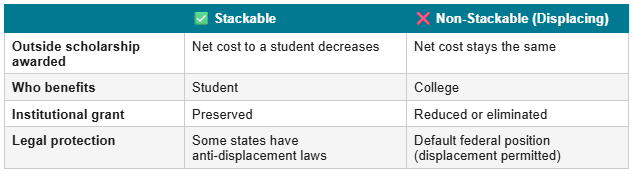
Scholarship displacement (also called award displacement or financial aid displacement) occurs when a college reduces your institutional financial aid - typically grants or scholarships awarded by the college itself - when you receive an outside (private or external) scholarship.
In practice: You win a $5,000 outside scholarship, expecting it to reduce what you owe the college. Instead, the college reduces its own grant by $5,000. Your out-of-pocket cost stays the same. The college simply pays less. The scholarship you worked hard to earn does not reduce what you owe. It reduces what the college owes - and the college pockets the difference.
Why it happens: Colleges determine your financial need by calculating the difference between their Cost of Attendance (COA) and the Student Aid Index (SAI). When total aid exceeds need, federal rules require colleges to reduce some form of aid. Colleges have discretion over which aid they reduce - loans, work-study, or grants. When they reduce grants, that is displacement.
You win a $5,000 outside scholarship. You tell your college's financial aid office. They reduce your institutional grant by $5,000. Your bill remains the same. The college simply contributes $5,000 less.
What Is Scholarship Stacking?
Scholarship stacking is the outcome every family hopes for: when a student combines multiple scholarship sources - outside scholarships, institutional scholarships, federal and state grants - and the college allows them all to count toward reducing the actual cost of attendance.
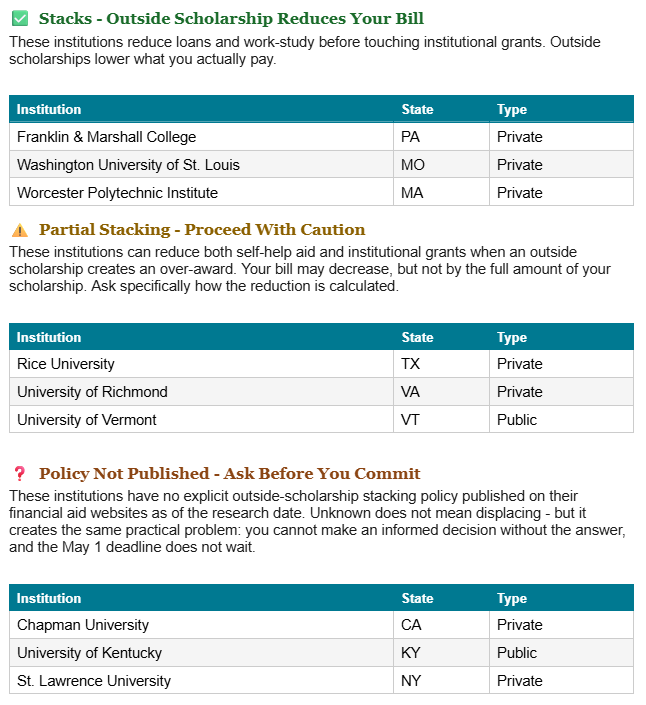
Partial Stacking is also common - and frequently misrepresented. When a college says, "we do not displace scholarships because we reduce work-study and loans first, not your grant," that is not full stacking. That is partial. The distinction matters enormously for your bottom line.
Stackable vs. Non-Stackable Aid
Why This Matters for Students and Families
The financial stakes are significant. A student who wins $10,000 in outside scholarships may see zero reduction in their net cost if their college fully displaces those awards. First-generation students and lower-income families - the students most dependent on institutional need-based grants - often are disproportionately impacted.
But beyond dollars, there is a time cost that rarely gets discussed. Scholarship applications take hours. Writing essays, gathering recommendations, meeting deadlines - that is, the time students spend away from studying, part-time work, extracurricular involvement, and the everyday demands of high school. If those scholarships are going to be displaced, that time was not invested wisely. Students and families deserve to know that before the search begins.
What the Law Does - and Does Not - Require
Federal law sets a ceiling (total aid cannot exceed COA) but imposes no floor on how institutions treat outside scholarships. The Higher Education Act encourages but does not mandate that institutions reduce loans and work-study before reducing grants. Institutions have wide discretion.
State law is where some meaningful protection exists. A growing number of states have passed or are developing anti-displacement legislation:
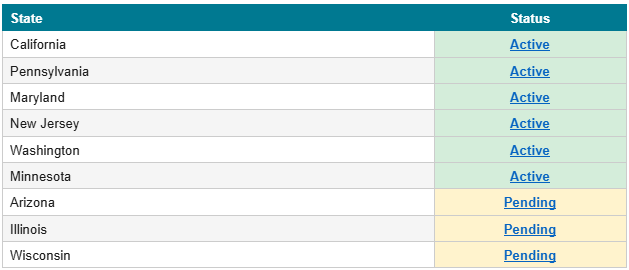
The fact that a student attends college in a state with an anti-displacement law does not automatically mean their institution complies or is covered. Private institutions may claim exemptions. This is exactly why you need to ask directly - and in writing - before you commit.
The Transparency Problem
Most families discover displacement in August, weeks before the fall semester, when they notify financial aid offices of awards received the previous spring. The Hechinger Report called this the "August Surprise." By then, the May 1 enrollment deadline will have passed. There is nothing to appeal.
Colleges are not required to publish their displacement policies. There is no standard financial aid policy manual that all institutions must follow. Every school handles it differently, policies change with institutional priorities, and the language used is rarely consistent.
When you ask a financial aid office whether they displace scholarships, you may get:
A strategically incomplete and technically accurate answer
Policy language that describes partial stacking as full stacking
A reference to general federal over-award rules that does not answer your question
No written policy at all
This is not always deliberate - some aid offices genuinely do not have a clear, consistent answer because the policy has never been formally written. But the absence of a written policy is itself information families should have.
The Questions to Ask - and When to Ask Them
When to ask is as important as what to ask. Waiting until after you are admitted can result in higher costs of attendance. These questions belong in the college research phase, while you are still building your list.
Questions to Ask Every College
What is your policy for outside (private) scholarships? Do they reduce my cost of attendance or your institutional grant?
Do you stack outside scholarships with your own institutional aid?
If I receive an outside scholarship, which component of my aid package will you reduce first: loans, work-study, or grants?
Is this policy published? Where can I find it in writing?
Does my state have a law protecting my aid from displacement, and does your institution comply?
Does this policy change based on whether I am need-based or merit-only?
When to Ask
As early as possible in the college search process.
During a college visit or college fair, when speaking with an admissions representative.
When you receive your financial aid award letter.
When comparing offers in March and April - before May 1.
When to ask is as important as what to ask. Waiting until after you are admitted can result in higher costs of attendance. These questions belong in the college research phase, while you are still building your list.
What Good Policies Look Like
Transparency is the baseline, not the bonus. Institutions with student-centered policies do the following:
Publish their outside scholarship policy clearly on the financial aid website
Specify which aid component is reduced first if an over-award occurs
Proactively communicate policy to students in award letters and at admitted student events
Reduce loans and work-study before touching institutional grants
Maintain work-study awards even when outside scholarships create over-award situations
When you are researching colleges, add this to your evaluation criteria. A college that will not tell you its external scholarship policy before May 1 is asking you to make a multi-year financial commitment based on incomplete information.
Institutional Scholarship Policy Database
The following examples are drawn from College Flight Path®'s institutional research database of colleges and universities, verified in May 2026. They illustrate how real policy differences translate to real financial outcomes.
Policies change. Always verify directly with each institution's financial aid office before making enrollment decisions.
Making Your Scholarships Work For You
Scholarship displacement is one of the most financially consequential and least understood aspects of the college process.
College Flight Path® works with students and families from the college search phase through enrollment, which means we are in these financial aid conversations from the very beginning. We know which questions to ask, which answers are incomplete, and how to appeal an adjusted award.
If you have questions about how the colleges on your list handle outside scholarships (or if you want to make sure you are building a list where your scholarship wins actually reduce your bill), we are ready when you are. Book your free 15-minute call HERE.