How to Write a Brag Sheet
Written by College Flight Path®
How to Write a Brag Sheet
Written by College Flight Path®
A college brag sheet template is a one-page form that captures a high school student's activities, awards, grades, test scores, and goals in one organized document. Students use it to help teachers and counselors write stronger recommendation letters, draft Common App activity descriptions, prepare for interviews, and build a resume for internships and scholarships.
The template below turns four years of scattered activities into a single reference document that everyone supporting the application can use. Download it, fill in what applies, update it each semester, and share it with the adults writing letters for your student.
Download the College Brag Sheet Template
The College Flight Path® Brag Sheet is a downloadable resource for recording academics, activities, leadership, work, service, and goals in one place. Pair it with the My Activities Spreadsheet to track ongoing involvement by year, semester, and role.
Using both gives students a central record they can return to when it is time to complete applications, request recommendations, update a resume, or prepare for interviews.
What Is a College Brag Sheet?
A college brag sheet is a structured summary of a student's high school record, written by the student and shared with anyone who needs a fast, accurate picture of who they are. The name is misleading. It is not about bragging.
It is a memory aid. A 2025 peer-reviewed study of 615,557 counselor recommendation letters submitted through Common App found differences in letter length and content across school and student characteristics. For example, private-school students received more sentences in several categories than public-school students. A brag sheet cannot solve those structural differences, but it gives a recommender clear, specific material to use.
Students can also use their brag sheet as a source document for the Common App activities section, scholarship applications, National Honor Society forms, portfolio descriptions, and job applications. One file, many uses.
If this brings up questions, book a free 15-minute call with College Flight Path.
What to Include in a College Brag Sheet Template
Every strong brag sheet covers the same core categories. Fill each one with specific details, not generic labels.
Academics and Coursework
List cumulative unweighted and weighted GPA, class rank if your school reports it, and the hardest courses taken each year. Include AP, IB, honors, dual-enrollment, and any summer coursework. Add SAT, ACT, PSAT, and AP exam scores with test dates.
A math teacher writing a letter for a student applying to engineering programs benefits from seeing the calculus grade, physics grade, and relevant AP score in one place.
Activities, Leadership, and Service
List every club, team, performance group, and volunteer commitment. For each entry, record the grade levels of participation, hours per week, weeks per year, and any leadership title. If you were team captain for two seasons, say so.
If you organized a fundraiser that raised a specific dollar amount, include the number. In its December 2025 deadline update, Common App reported an average of 5.38 applications per applicant through December 1, 2025. A concise, detailed activity record makes it easier to adapt the same experience for different applications.
Awards, Jobs, and Special Projects
Name each award, the issuing organization, and the year. For jobs and internships, include the employer, the role, the dates, and two or three bullet points describing what you actually did. Independent projects belong here too: a science fair entry, a podcast, a published article, or a coded app.
Use action verbs and add measurable results whenever possible: taught 16 kids to swim, raised $2,500 for the food pantry, or coded a mobile app with 400 downloads.
Goals, Interests, and Personal Context
Write two to four sentences about what the student is considering studying and why. Undecided is fine, but a direction such as “interested in biology or environmental policy” is more useful than “not sure yet.”
Add one or two notes about personal context a recommender might not know, such as a family responsibility, a health challenge that affected a semester, or a passion pursued entirely outside school.
How to Fill Out the Template
The template is easiest to complete when the student works in short sessions and keeps the file updated.
Start with the easy facts. Add name, address, school, graduation year, counselor name, and unweighted GPA.
Work backward through each school year. Start with the current year and move backward. It is often easier to remember the last six months than the last three years.
Write with action verbs and outcomes. Use verbs such as led, built, raised, taught, organized, designed, wrote, and coached. Pair them with a measurable result when you have one.
Keep a master version and tailor copies. Save one master file. When a teacher asks for a brag sheet for a recommendation, make a copy and highlight the activities and examples most relevant to that class or subject.
Update it every semester. Set a recurring reminder for the end of each semester and after each summer. This prevents senior-year panic.
How a Brag Sheet Helps With Teacher Recommendations
Specific, accurate information gives a teacher material for a more personal recommendation. A brag sheet is a simple way to provide that information without asking a recommender to chase down details.
The 2025 Common App teacher brag sheet asks students to describe a lesson they enjoyed, a project they were proud of, an example of a personal attribute such as leadership or initiative, and something the teacher may not know about them. Those prompts are useful starting points when preparing information for any recommender.
Ask early and follow the deadline set by the teacher, counselor, or school. Attach the brag sheet when you formally request the letter. A short note like this works:
I've attached my updated brag sheet with my activities, test scores, and a few moments from your class I'm proud of. I'm happy to share more details on any item.
For a recommender who has only seen a student in one class, the brag sheet can reveal the robotics competition, internship, or family responsibility that would otherwise be missing from the letter.
How to Use Your Brag Sheet for Essays and Resumes
A brag sheet can be the starting point for every piece of writing in the application.
For essays, circle three to five entries that carry real meaning, not just the most impressive ones. Ask, “Why does this matter to me?” for each. Patterns emerge quickly: teaching, building, helping, persisting, and making. Those patterns can become essay themes.
Our guide to the five themes for a compelling personal statement walks through how to move from a brag sheet bullet to a full draft. The brag sheet also helps essay coaches and teachers spot topics a student should avoid repeating across the Common App essay, supplements, and activities section.
For a student resume, pull the contact block, the top five or six activities with leadership detail, paid work, and two or three awards. Rewrite each bullet in resume style: action verb + task + outcome.
A well-built brag sheet makes a one-page resume easier to draft. If you are still deciding which activities to feature, our guide to the best extracurriculars for college applications offers guidance on choosing and presenting involvement.
Optional Sections to Add
Some students add a short testing log with SAT, ACT, AP, IB, and superscoring notes, especially if they have tested more than once. Others add a portfolio section for art, music, film, writing, or research, with links to each piece.
A third useful add-on is an interview-prep section with two or three anecdotes and prepared answers to common questions. None of these are required, but they can make the brag sheet useful throughout application season.
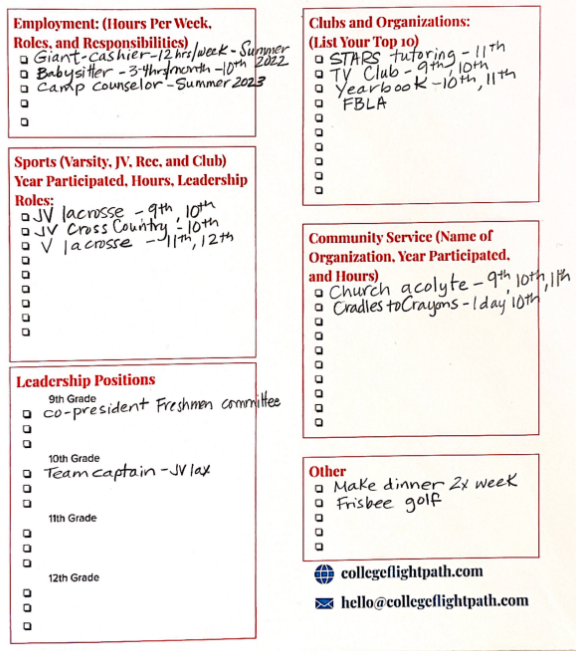
Brag Sheet Example
Use the College Flight Path brag sheet template as a starting point, then make each entry specific to the student. The goal is not to make every activity sound impressive. It is to create an accurate record of what the student has done, learned, and contributed.
Work through each section, then share the completed sheet with the adults supporting the application.
Putting the Brag Sheet to Work
A brag sheet is most useful when someone uses it to make decisions: which essay topic to pick, which teacher to ask, which activity to feature on the Common App, or which scholarship to pursue.
Building the sheet is the first step. Using it to shape recommendations, essays, and interview answers is where it becomes valuable.
Get Support That Matches Where Your Student Is Right Now
College Flight Path helps families at every stage of the process, and the brag sheet connects with many of its services. Pick the entry point that fits where your student is today.
If your student is in 9th or 10th grade and just starting, academic planning can help build a four-year course plan, identify appropriate rigor, plan summer experiences, and maintain a current record of activities.
If your student is a junior building a college list, college counseling can use the brag sheet as a working document for list building, essay brainstorming, and recommendation strategy.
If your student is a senior writing essays and managing deadlines, the Self-Guided Senior Flight Log course provides structure for the brag sheet, Common App, supplemental essays, and submission checklist.
If testing is the current bottleneck, test preparation and the College Flight Path tutor network can help students plan retakes, superscoring, and score-send strategy. Those details belong in the testing section of the brag sheet.
If the financial side is the real question, financial aid support can help families navigate the FAFSA, CSS Profile, scholarship strategy, and net-price comparisons. A detailed brag sheet can also support scholarship applications.
If your student is looking beyond college to a first job or internship, Career Flight Path extends the brag sheet into resume writing, LinkedIn, networking, and interview preparation.
Start With the Tools
Two useful resources to explore first are:
The College Flight Path® Brag Sheet template covered in this article.
The My Activities Spreadsheet, which tracks involvement semester by semester and pairs directly with the brag sheet.
Use them to maintain a single master record of your student's high school career, then return to that record whenever an application, recommendation, essay, scholarship, resume, or interview calls for it.
Book a free 15-minute consultation with College Flight Path® HERE.
Copyright © 2025 College Flight Path. All Rights Reserved.
Need Help Writing Your Brag Sheet? We Can Help in the Flight Log!