What Is Actually Happening in College Admissions Right Now
A CFP Perspective on the 2025–26 Landscape and What It Means for Your Family
Written by College Flight Path®
Every spring, we sit with what the most recent admissions cycle has revealed. This year, the signals are louder than usual. Higher education is navigating a convergence of financial pressure, policy disruption, and shifting student behavior that is unlike anything we have seen in a single cycle. Understanding what is driving this landscape is not a matter of staying informed for its own sake. It is the difference between making a sound college decision and reacting to noise.
This post lays out what is happening, why it matters, and how to position your student to navigate it with confidence and clarity.
The Financial Ground Beneath Colleges Is Shifting
For more than two decades, colleges have been quietly subsidizing most of their students to stay competitive. Elite institutions expanded access through generous need-based aid, meeting 100 percent of demonstrated financial need for families who qualify. A broader group of colleges responded to declining enrollment pressures by escalating merit scholarships, effectively discounting tuition to attract higher-achieving students and improve their standings in the rankings. The collective result: private colleges are now discounting tuition by an average of 56 percent. For every dollar a private college could theoretically charge, it collects roughly 44 cents.
This model has worked, just barely, while federal research funding and state appropriations held steady. Now, both are under significant pressure simultaneously. Add to that a new sliding-scale endowment tax that will cost Harvard alone an estimated $300 million annually and Yale roughly $280 million in the first year, a reduction in international enrollment due to visa difficulties, new federal student loan caps that take effect this summer, and a Department of Education that has lost nearly half its staff while transferring the $1.7 trillion loan portfolio to the U.S. Treasury. The financial ground is shifting, and it is doing so quickly.
What does this mean for families? It means that the net cost of college is increasingly unpredictable, and merit aid is both more available and less stable than it has ever been. Families who understand this will approach the college list as a financial strategy, not just an admissions strategy.
What This Means for Smaller and Regional Colleges
Some of the most consequential implications of this landscape involve the colleges that are least discussed in popular admissions conversations. Roughly 40 percent of private colleges and 20 percent of public colleges are currently running deficits. Over the past decade, more than 120 colleges and universities have closed or merged. The Huron Consulting Group projects that up to 400 institutions could close or merge in the coming decade.
For families who want to see how specific institutions are positioned right now, researcher Kyle Saunders has mapped 1,556 U.S. colleges and universities across two dimensions: Institutional Resilience (the ability to absorb financial and enrollment shocks) and Post-College Market Position (how well an institution prepares graduates for the labor market ahead). His analysis finds that 37 percent of institutions are simultaneously shrinking and structurally stressed — a category disproportionately concentrated among Baccalaureate and smaller Master’s-level schools in the Midwest and Northeast. Fifty percent of Baccalaureate institutions fall in what Saunders classifies as the High Stress quadrant. You can explore where a specific school lands at kylesaunders.com/university-map.
These closures are not abstractions. A college closing mid-enrollment can displace hundreds of students. A campus that is financially distressed may cut programs, reduce faculty, or defer maintenance in ways that meaningfully affect the educational experience, sometimes without adequate warning to incoming students.
Here is the nuance worth understanding: not all smaller colleges are in the same position. The 26 wealthiest small institutions are now exempt from the new endowment tax entirely, having fallen below the threshold that triggers it. Some of the most financially resilient colleges in the country are small liberal arts colleges with strong endowments and low overhead. The blanket assumption that a larger, more recognizable school is the safer bet does not hold under scrutiny.
This is precisely why we center every college list around our Beyond the Brand Name framework. Academic fit, relational support, experiential learning, financial sustainability, and cultural and community fit are the five dimensions that predict whether a student will thrive. A school with a name you recognize is not automatically a school where your student will succeed.
Testing Is Coming Back, and Grade Inflation Is Why
For the first time since the pandemic, more students submitted test scores than withheld them in this cycle. The trend is directional and likely to accelerate. All of the Ivies except Columbia now require test scores. Purdue describes itself as test-optional in name but expects scores in practice. Southern flagship universities are increasingly returning to score requirements. More early decision and early action programs are incorporating scores into their review processes.
The driver is grade inflation. Transcripts have become difficult to interpret. When the majority of applicants present near-perfect GPAs, standardized scores become the most reliable independent signal of academic preparation. Recent research published in early 2026 found that grade inflation is not simply a cosmetic problem. It correlates with worse academic outcomes and reduced employment prospects because students who are not challenged do not build the mastery or persistence that difficult work requires.
Admissions offices are also increasingly scrutinizing AP scores as an additional measure of content mastery. The University of California system, which is test-blind for the SAT and ACT, actively evaluates AP scores. Emory reviews them closely. Caltech requires submission from students who have taken AP courses. This is a meaningful shift in how academic performance is being verified.
The practical implication: testing is no longer optional in spirit, even when it is optional in policy. A strategic, unhurried approach to test preparation remains the right course. Rushing to a score before a student is ready serves no one. The goal is a score that accurately represents a student's ability, taken when they are prepared and confident.
Is this bringing up questions for you? Reach out to schedule a 15-minute call, book yours HERE.
Early Applications Now Outnumber Regular Decision Applications
This is not a small trend. Early applications have now surpassed regular decision applications for the first time in recorded Common App history. The shift reflects colleges working deliberately to yield their classes earlier, offering more seats and more financial aid in early rounds. Each year, the proportion of a class filled in EA and ED rounds grows. Waiting for regular decision at many institutions now means competing for a significantly reduced pool of spots.
Next cycle, WashU and Connecticut College are adding Early Action deadlines. The University of Southern California is making Early Decision available for all majors. The direction is clear.
What this does not mean is that every student should apply Early Decision. The distinction we make with every family is straightforward. If maximizing selectivity advantage at a specific school is the priority, and financial aid is not a primary concern, binding early decision can be a meaningful strategic choice. If maximizing financial flexibility is the priority, Early Action and Regular Decision allow a student to compare offers, appeal for more merit aid, and make a fully informed financial decision. That process can extend past May 1 and into the summer in some cases. Patience is not a liability here. It is a strategy.
Merit Aid Is More Negotiable Than Most Families Realize
This cycle produced something our team found genuinely notable: merit scholarships appeared at institutions that had historically awarded none, and families who appealed had more success than we have seen in prior years. The Department of Justice issued an antitrust directive following the Varsity Blues investigation that was designed to stimulate financial competition between colleges, and that directive is working its way through admissions culture.
Several colleges independently raised merit awards before and after students made enrollment decisions. Students weighing Division III athletics chose programs offering large academic merit packages over more selective options. Families who were strategic about appeals recovered meaningful aid.
The upcoming Parent PLUS loan caps, which will limit annual borrowing to $20,000 and lifetime borrowing to $65,000 per student beginning July 1, are accelerating this dynamic. Colleges that want to yield a class understand they need to be financially competitive. This is a moment where families who advocate effectively will benefit.
What does that look like in practice? The following are outcomes CFP helped families achieve in the most recent cycle.
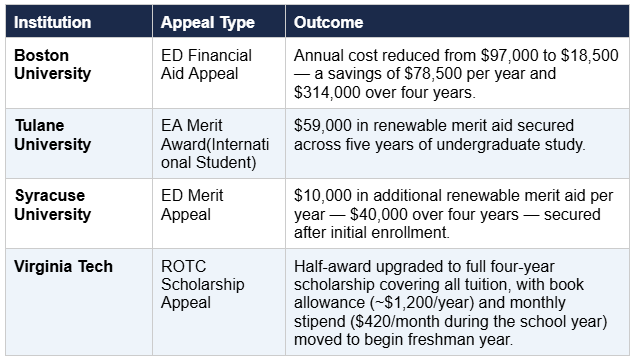
These outcomes are not anomalies. They are the result of knowing how to read an aid package, understanding the right channel for each type of appeal, and building the case with documentation and precision. The process is standard. What varies is whether families know it exists and whether they have someone to guide them through it.
What CFP Advises in This Landscape
The families who will navigate this cycle best are those who treat the college decision as what it actually is: a four-year investment in a specific environment, evaluated across multiple dimensions, made with full financial information rather than partial information filtered through rankings and reputation.
Practically, that means:
Build the college list as a financial strategy. Understand net cost at every school, not sticker price. The most competitive schools for need-based aid and the most generous for merit aid are not always the schools with the most recognition.
Do not assume that a well-known school in financial difficulty is safer than a smaller, financially stable one. Read the institutional signals. Ask about program stability, faculty tenure rates, and deferred maintenance on your campus visits. Use the Saunders map as a starting point.
Treat testing strategically and without urgency. A student who is genuinely prepared scores higher than a student who finished prep on a rushed timeline. Colleges care about the score, not the date it was achieved.
Apply early where it is the right strategic choice for your specific goals, not because the calendar pressures you. Early decision is a binding financial commitment. Make it with full information.
Engage with financial aid appeals. They are standard, they are expected, and they work more often than families realize, particularly in this environment.
Keep your student off the social media comparison cycle. The research is clear: exposure to other students' admissions outcomes raises anxiety and distorts decision-making.
Higher education is at an inflection point. But uncertainty is not the same as chaos, and it is not a reason to make defensive, reactive decisions. Students who understand how this system works and who have a clear picture of what they are looking for in a college environment are better positioned now than they would have been in a simpler market.
That is the work College Flight Path® was built to do.
Ready to build a college strategy grounded in fit, not fear; book a 15-minute call HERE.
Copyright © 2026 College Flight Path. All Rights Reserved.